Low Carb Living
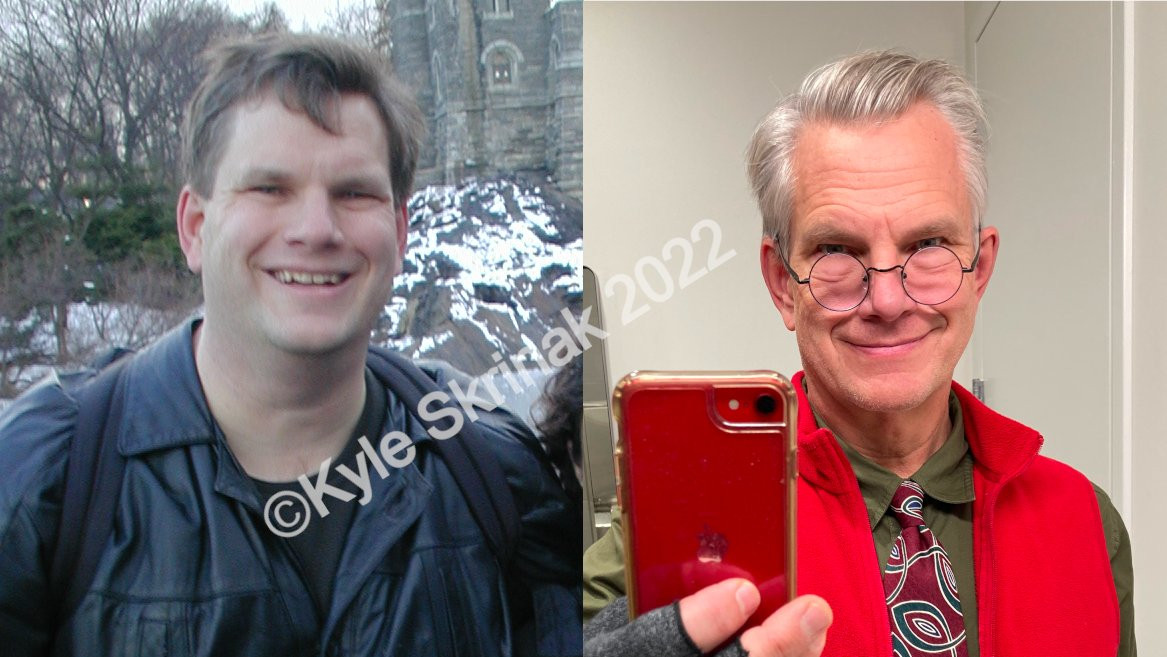 A self-portrait. Left - me when I was 40. Right, me, at 60.
Summary
For decades, general physicians, nurse practitioners, dieticians, nutritionists, and advocacy groups have poorly advised us — and, most certainly, me — about what constitutes a healthy diet. By ignoring mainstream nutritional advice, the food pyramid, and other common myths about what’s healthy, and by shifting to a nearly opposite way of eating, I’ve lost weight, kept it off, and improved my health markers.
I’m describing a low-carbohydrate diet.
Introduction
In my first few years, many people were kind to me and commented on my weight loss. I used to hear, “You look great! You must be hitting the gym pretty hard?” My answer was that it’s not the gym. I’ve been hitting the gym “pretty hard” for at least a decade, if not longer. I started my running habit in college, back in 1982. In my youth, exercise seemed to be the key to weight management. However, as I aged, my amount of activity ceased to benefit my weight management. Indeed, I found it had nearly no benefit.
Update: since I initially wrote this in 2017, I have maintained my weight loss. People have forgotten how obese I used to be. That is what we call an “NSV,” or “Non-Scale Victory.” However, I still hear kind comments from old friends I haven’t seen in years.
I had been obese my whole life. In high school, I was the kid who was four laps behind the slowest kid in Phys Ed class. The term in the ’70s for us, overweight teens, was “husky.” Since then, I’ve been on nearly every diet, from Weight Watchers, Shaklee, Nutrisystem, Jenny Craig, South Beach, standard calories-in, calories-out diets, Dr. Atkins, to finally, low-carb.
It Begins
In the spring of 2016, after my yearly checkup, my general practitioner noted on my chart that I was obese, with a Latin term that meant “belly fat.” My weight was 295. His dietary prescription was essentially, “You know, move more, eat less.” Despite my numerous previous failures, I resolved to try again, yet again. That summer, I meticulously, if compulsively, tracked what I ate with an online macro and calorie counter. I tried reducing sugar while including generous servings of “healthy” starches, such as corn or whole wheat. I dramatically increased protein intake, most often through whey shakes. I saw moderate weight loss, 20 pounds, but the holiday triumvirate of Thanksgiving, Christmas, and New Year’s Day caused my weight loss to stall and climb into January and February. It was the return of an old and familiar pattern.
Quite serendipitously, while browsing the official Duke University video feed, I found a presentation featuring Dr. Westman of Duke University, giving a talk titled “The Science and Practice of Low Carb Diets.” I had done the Atkins diet with great weight-loss success, only to backslide after I failed to correctly follow the Atkins maintenance plan, to the point of complete remission. I guessed that I needed expert help. What if I had the help of a doctor, especially a doctor who had taken the mantle from Dr. Atkins? My GP gave me a referral to see Dr. Westman.
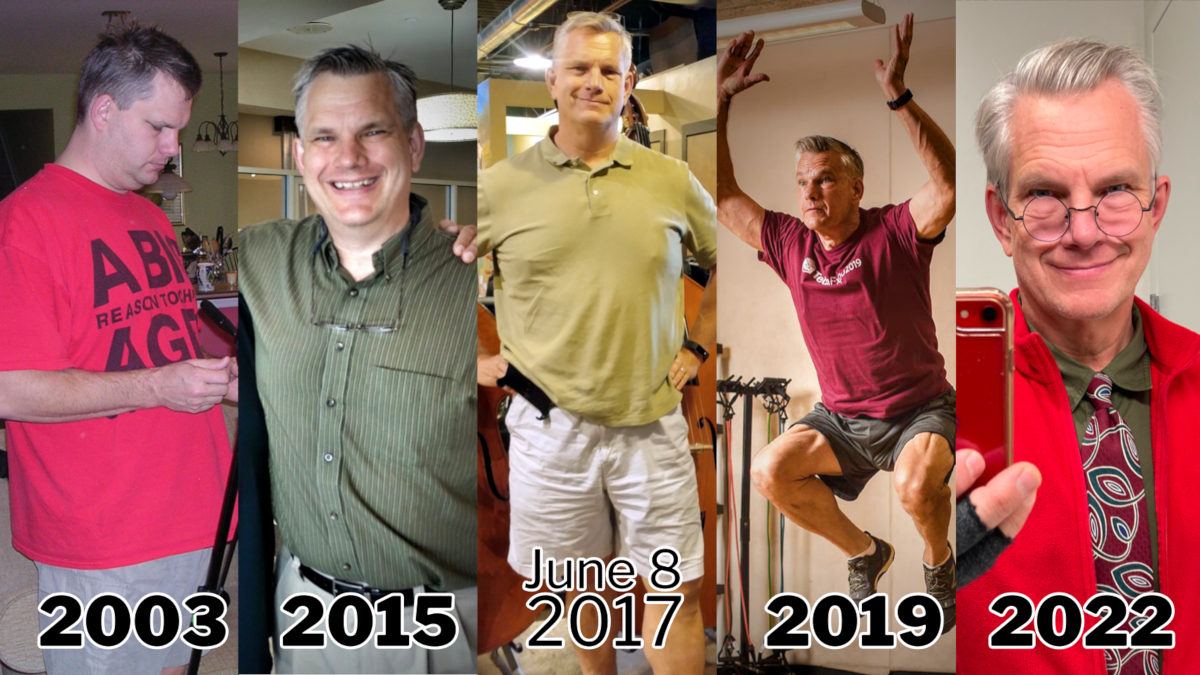 Me, through the years, from obesity and sore joints to health management.
The Road to Damascus
On June 8, 2017, I started my low-carb diet under the direction of Dr. Eric Westman. His method is both radical and simple. He flips the food pyramid upside-down with his famous “Page Four” reference for his patients. “Page Four” is the fourth page of a handout he gives his patients to help them with what to eat and how much to eat. Dr. Westman then follows up with a 45-minute class with his recent initiates. You can see this in his infamous “white coat” video at this link. He discusses what one can eat, what to eat in limited quantities, and what to avoid. He helps his patients identify starchy and sugary foods that people commonly confuse with healthy food.
June 8 was also the first day I took a long road trip with my daughter to help her move to Dallas, Texas, for a college internship. While the trip was interesting on its own, I was starting my diet away from the creature comforts of my home kitchen. Dr. Westman’s plan is brilliant for such ad-hoc situations, I learned. I also experienced the first “Oh, my” NSV of completely losing my driving-induced (or carb-induced?) narcoleptic response. Previously, I could only drive for up to 90 minutes before having to pull over and nap for 15 minutes. On this trip? I could drive, and drive, and drive. It was fantastic, though I hadn’t quite made the connection yet.
After initial resistance, as in, “I must be destroying my cardiovascular system, but I have nothing to lose by not trying.” I came to love his simplified approach. He advises against macro-counting. He works with his patients to keep things simple. While there’s a lot of exciting research, analysis, and testing around all this, all the details can make this wealth of information sometimes conflicting, confusing, and dispiriting for the beginner.
Stasis, homey
Nearly six years along now, I continue to enjoy sustained weight loss and improved health, and I’m only getting started. I have seen many wrinkles, hiccups, delights, and failures along the way, and I’ll be sharing my experiences on this blog. I expect to continually update this page, refining it to reflect my evolving understanding of the science and art of low-carb living.
I love this way of eating and despise all the misinformation that has messed up an entire nation’s culture and understanding of something as essential and as necessary as food.
I came for weight loss and found a healthier way of living.
Last updated: 2026-02-16
Resources
Websites
- Dr. Eric C Westman’s Scholars@Duke profile
- Dr. Westman’s Facebook group page.
- Adapt Your Life shares LCHF information with the public, working with Dr. Westman and others in the medical or scientific community who are leading on various related topics. They also maintain an active YouTube channel.
- Amy Berger, Tuit Nutrition, a Certified Nutrition Specialist, focuses on “Keto without the Crazy,” and the crazy is getting worse at an increasingly crazy rate. Not everyone who studies or promotes low-carb eating follows a protocol that overlaps with theirs, but my experience is that she and Dr. Westman’s protocols overlap quite well.
Podcasts
- Heh. I used to listen to quite a few low-carb podcasts. In time, I found out that all this information consumption only added confusion and complexity to Dr. Westman’s simple plan. As listed above, Dr. Westman and Amy Berger publish a lot of information. I’ve come to appreciate that that’s all I need.
Social Networks
- I roughly maintain an “X (formerly Twitter) list” that you can find here. My X handle is available in the footer. Note: I spend very little time there these days. In fact, it’s in my best interest to get off social media.
Books and Authors
-
No surprises here, but I’m recommending “End Your Carb Confusion” by Dr. Eric Westman and Amy Berger. I haven’t read it, though it is in the “want to read” queue. I have no doubt it is an excellent reference. Here is the description from the book:
Overwhelmed by the avalanche of information out there about diets and health? Tired of spending time and money following complicated and expensive plans and protocols that don’t deliver the results you want? Would a strict ketogenic diet be best for you? But what if you can’t imagine life without fruit or bread? Why won’t someone just make all this diet stuff simple?
They have! Eric Westman, MD, has over twenty years of experience as an internal medicine doctor and obesity medicine specialist. He’s helped patients at his Keto Medicine Clinic at Duke University lose over 26,000 pounds and reverse conditions like type 2 diabetes, PCOS, high blood pressure, and more. In End Your Carb Confusion, he shares his time-tested and science-backed strategy with YOU!
-
Anything by Gary Taubes.
- If you only read one work of his, make it his New York Times article “What If It’s All Been a Big Fat Lie?” This article kicked off broader acknowledgment that we’re dangerously heading down the wrong path on the science and practice of nutrition.
-
Anything by Nina Teicholz
- I highly recommend her book, “THE BIG FAT SURPRISE; Why Butter, Meat & Cheese Belong in a Healthy Diet”, which explains how we got here and offers possible remedies.
My Low-Carb Blog Posts
You can find all my LCHF-related posts by searching for “LCHF” or “low carb” on the blog or using the search feature. Note, I don’t say “keto,” as “keto” has become too ambiguous to be helpful.